Advertising pylons and totems — when a facade sign is not enough
A building set back from the road, or several firms at one address — a wall sign does not work there. When you need a pylon and how it is made.
When a facade sign stops being enough
A sign on a building wall is seen by whoever stands opposite it. If the building sits tens of metres from the road, behind a car park or a fence, a driver passes the entrance before reading the name. The same problem affects sites where several companies operate at one address, and premises on through roads where the decision to turn is made in a second.
Advertising pylons and totems are signs visible from a long distance that direct customers straight to a company. They stand where the customer makes the decision — at the entrance, by the road, in the car park — not where a wall happens to be.
This article explains the types of pylons and totems, how to illuminate them, what to do about the foundation and the formalities, and what to prepare for a quote.
Pylon, totem, advertising wall — which is which
The names are often used interchangeably, but they differ in scale and purpose. The table below sorts out what a quote refers to.
| Type | Scale | Typical location | Job |
|---|---|---|---|
| Totem | Compact, human height or slightly taller | Entrance, car park, before the door | Confirm the address and direction |
| Pylon | Tall, large format | By the road, on the access route | Be visible from afar, from a moving car |
| Advertising wall | Wide, low or medium | In front of the building, against the facade | Name, logo and message in one |
| Multi-tenant pylon | Tall, divided into panels | Entrance to a complex or business park | Several companies on one sign |
The steel structure — why it is not a big lightbox
A pylon differs from a facade lightbox in one fundamental way: it stands on its own. There is no wall holding it, so it must carry its own weight and the wind load down to a foundation. That is why we design and build stable steel structures made for years of use — not the place to save money, because everything hanging above depends on it.
On the structure we mount the light signs: illuminated lightboxes and other elements matched to the format. The sign itself is replaceable — the structure stays when, years later, the logo or the company name changes.
For the same reason a pylon is not designed by eye. Height, face area and location translate into wind load, and that into steel sections and the size of the foundation. The earlier those parameters are known, the fewer changes after the first visualisation.
Illuminating a pylon — LED lightbox, glass neon, letters
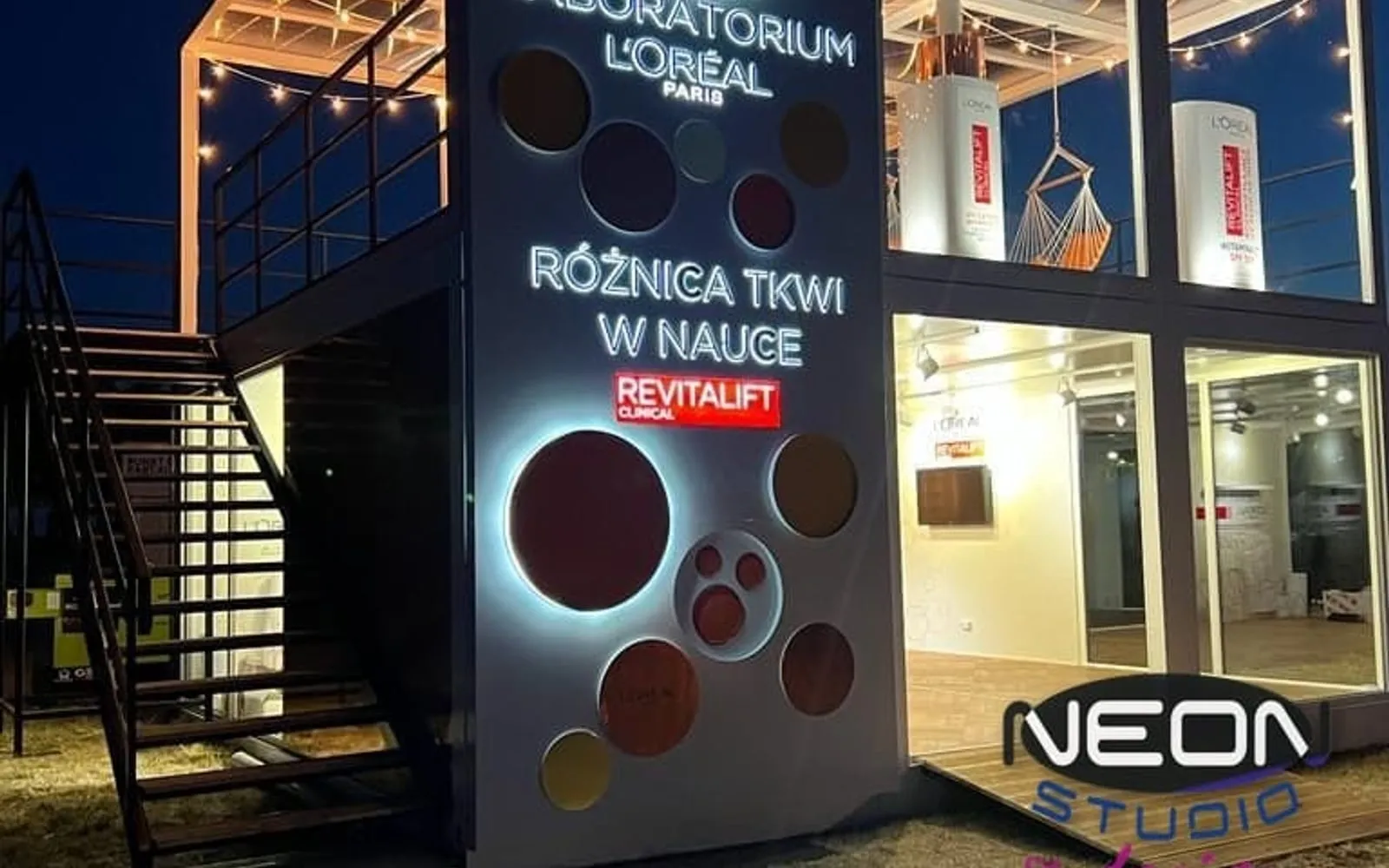
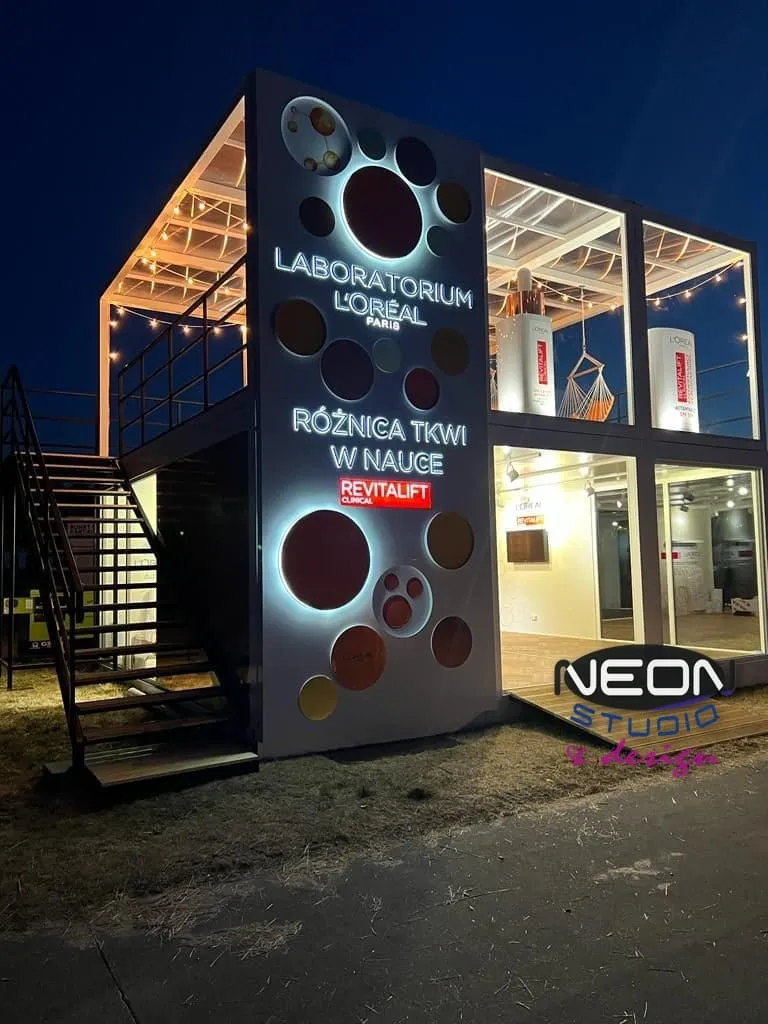
Illumination ensures visibility after dark too, and for a sign by the road that is half its job. Most often we use LED-backlit lightboxes: a large, uniform glowing surface is legible from a moving car. For the L'Oréal Laboratory we built an advertising wall imitating a pylon, with LED illumination — it reads as a solid form by day and glows through its lettering and graphics at night.
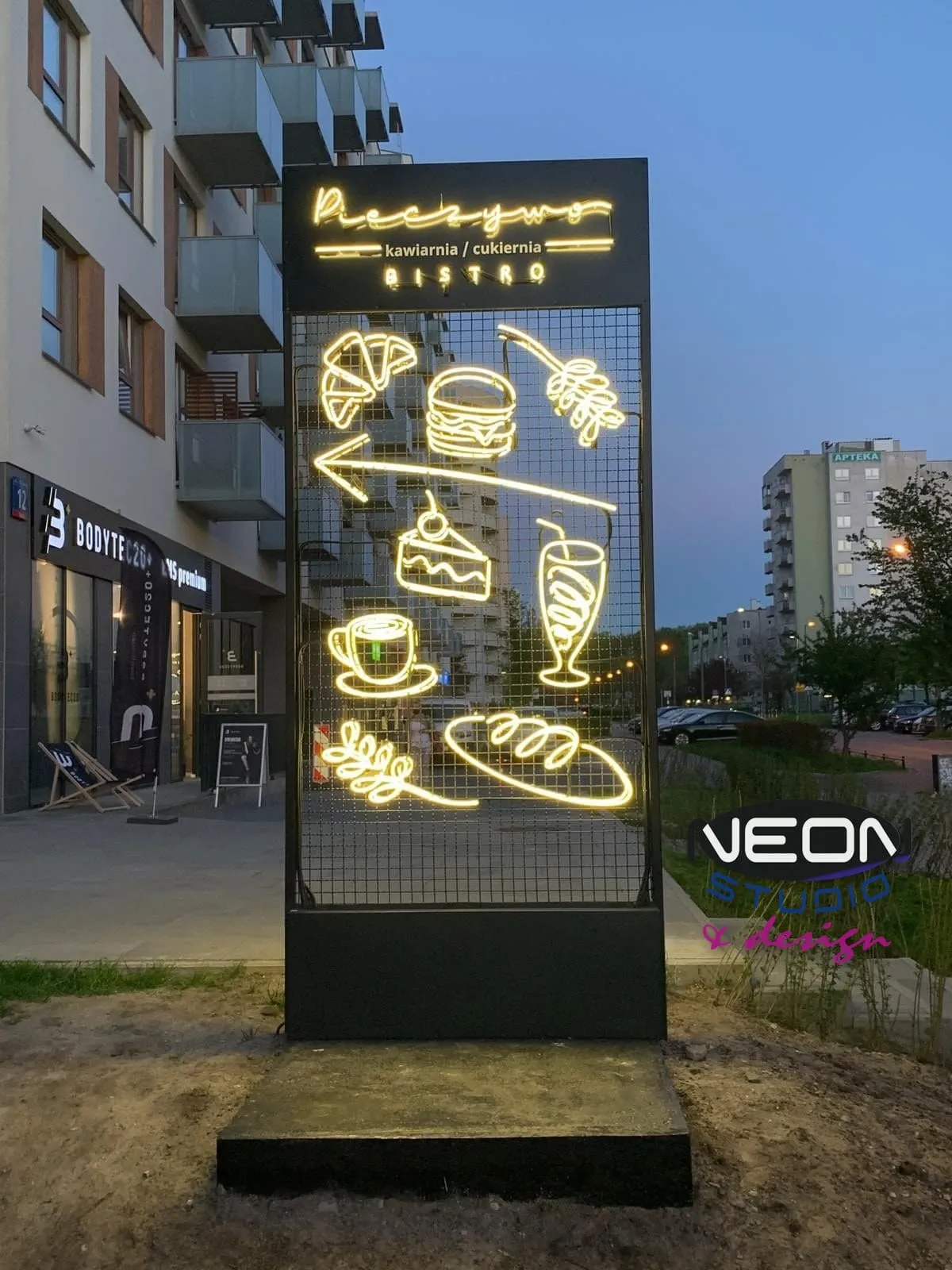
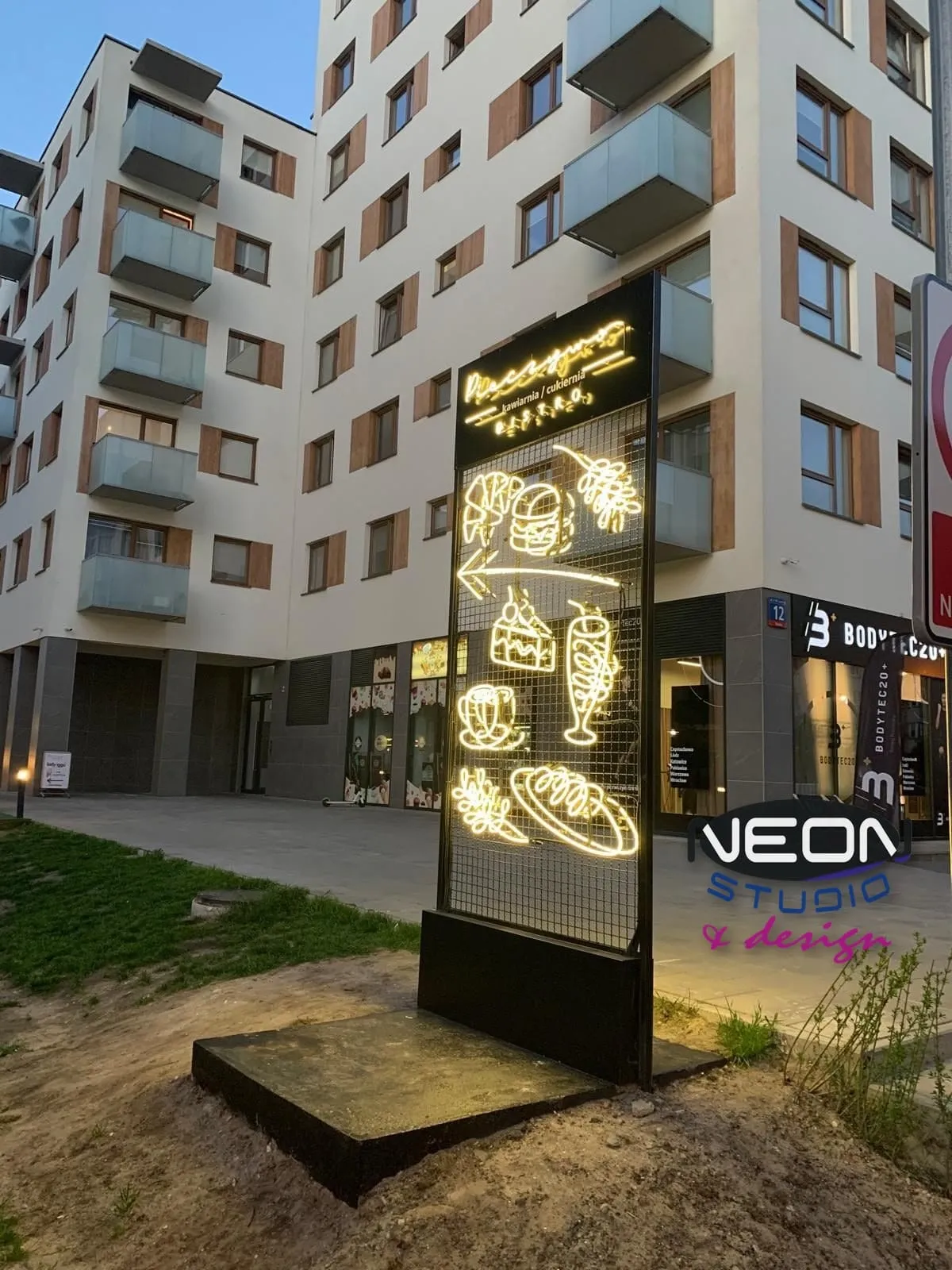
A pylon can also be lit with traditional glass neon, as in one of our projects for a restaurant — then the sign not only informs but builds the character of the place. We advise on location, format and illumination for the specific situation.
Location and direction: where should the customer see it from
Before designing, we stand where the customer is supposed to make the decision and look at what is visible. A roadside pylon must be legible from both directions of travel — which is why it is usually double-sided. A totem at the entrance confirms the address to someone who has already slowed down. A wall in front of the building aimed at pedestrians and people parking.
The second question is distance: from what farthest position should the sign be read. That decides the letter height and how much content fits on the face without losing legibility — on a roadside pylon, less is more.
Already have a project in mind?
Get a free quoteThe multi-tenant pylon — several companies, one sign
In business parks, by warehouses and in service complexes the most common form is a pylon divided into panels, one per company. Such a sign needs two things agreed from the start: who owns the structure, and how a single panel is replaced when a tenant changes.
The panels are best designed as replaceable modules from the start, so changing one logo does not mean dismantling the whole pylon. Consistent signage in line with each brand's identity then fits on one sign without chaos.
Good practice is to settle the rules from the start: who pays for replacing a panel, how soon after a tenant changes it has to happen, and who is responsible for servicing the whole sign. Without that, after a few years the pylon has empty or outdated panels, which harms every company on it.
Structural design, foundation, power
A pylon is a freestanding structure, so beyond the graphic design it needs a structural design, a foundation and power run to where it will stand. Those three things are worth planning before the first visualisation, because they decide where the sign can physically go.
We take care of the structural design, production and on-site installation. Formalities must be checked before production: a pylon permanently fixed to the ground counts as a structure under Polish building law, so it usually needs a notification or a building permit, and in municipalities with a landscape resolution or a local plan it must fit their rules. We advise what to check — the decision rests with the authority.
It is worth planning control along with the power — an astronomical timer or a dusk sensor — so the pylon glows exactly when it is needed.
Our pylon projects
For the L'Oréal Laboratory we made an advertising wall imitating a pylon with LED illumination — a project we photographed by day and at night, because it shows both faces of such a sign. For the Orto Viva clinic we built an advertising pylon complementing the halo-lit letters on the facade: the pylon directs at the entrance, the letters confirm on the building.
A separate group is pylons with glass neon and unusual signs, such as a freestanding 3D lightbox. All are made in our workshop near Warsaw and travel to the site with our own transport.
From design to installation — one company
A pylon brings several trades together: graphic design, structural design, steel fabrication, light sign production, electrics, transport and installation with a foundation. Split between different contractors it usually ends with nobody responsible for the whole. With us the job is end-to-end: design, production, transport and installation under one roof.
We install ourselves, including electrical connections, and after start-up we provide servicing and maintenance — also for signs that over time need a new face or illumination.
What to prepare for a pylon quote
The quote is free and carries no obligation. For a pylon, information about the site helps — things we do not need for a facade sign.
The more of this you give us upfront, the sooner we come back with a visualisation — a pylon is designed from the ground up, so the first questions are always about the site and its surroundings.
- —Photos of where the pylon will stand — from the road, from the entrance, from the building side.
- —The approximate distance from the road and the distance from which the sign should be legible.
- —Whether the sign should be single- or double-sided, and whether you expect more than one company.
- —Whether power is available at that spot or has to be brought in.
- —The logo as a vector file and brand guidelines, if the company has them.
- —Who owns the land the structure will stand on.
Frequently asked questions
- What is the difference between a pylon and a totem?
- Scale and purpose. A totem is compact and stands at the entrance or car park to confirm the address. A pylon is tall and large-format, stands by the road and is meant to be visible from afar, from a moving car. We make any format — from entrance totems to large roadside pylons.
- Does a pylon need a foundation?
- A pylon is a freestanding structure carrying its own weight and the wind load, so it needs a structural design and proper foundations. We take care of the structural design, production and on-site installation.
- How is a pylon illuminated?
- Most often with LED-backlit lightboxes, legible from a moving car. Illumination with traditional glass neon or 3D letters is also possible. We advise the illumination method for the location and format.
- Do you make pylons for several companies at once?
- Yes. A pylon for several companies is best designed with replaceable panels, so a change of one tenant does not require dismantling the whole structure, and every brand keeps consistent signage.
- Do you handle installation and power?
- Yes. We deliver end to end: design, production, transport and on-site installation, including electrical connections. After start-up we provide servicing and maintenance.
- Does a pylon require formalities?
- Almost always. A pylon permanently fixed to the ground counts as a structure under Polish building law — it usually needs a notification or a building permit, and where a landscape resolution or local plan applies, it must comply with them. By a public road the road authority's consent is needed too. We advise what to check and which documents to prepare, but the decision rests with the authority — so it is worth starting there, before the first visualisation.